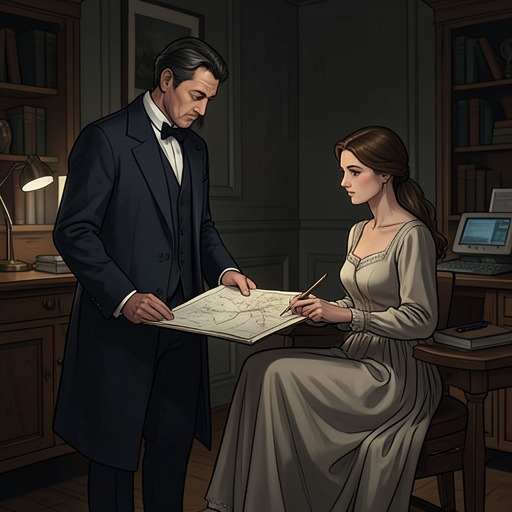
Avenging agents of Lady Love
One Thousand and One NightsAvenging agents of Lady Love are Tad and Claire, the paired investigators appointed to right wrongs for Lady Love. The role gives them a mandate to pursue cases, but its defining condition is their dependence on one another: Tad’s claim to be the principal agent and Claire’s supposed status as an assistant are overturned by Lady Love’s revelation that their magic is entwined, making cooperation a condition of their work rather than a matter of rank.
Appointment and Authority
Tad initially describes himself as the avenging agent and calls Claire only the assistant agent, or an agent in training, a title he says he gave her out of pity. Nan corrects him directly: Lady Love made both of them her avenging agents. Their authority therefore comes from a shared appointment, not from Tad’s self-assigned hierarchy. His insistence on seniority exposes the tension at the heart of the partnership: he wants recognition as the indispensable investigator, while the commission belongs equally to both.
Lady Love later confirms that she deliberately left them to their own devices on a case so they would learn from trying to work separately. She also makes clear that she did not intend to choose which servant was more valuable. The assignment is thus more than permission to investigate: it is a framework in which their conduct and assumptions about each other are tested. Lady Love watches their attempt to establish individual importance and treats the resulting ordeal as a lesson in the limits of rivalry.
Mandate in Practice
The title carries an active duty to right wrongs. When Tad confronts Prudence, he identifies himself as an avenging agent and says he has come to address a terrible wrong; he demands a full confession and offers to plead her case before his patron. His approach makes the role’s authority visible in practice: he invokes Lady Love’s standing while presenting himself as an investigator empowered to pursue an admission and seek redress. Prudence immediately confesses to stealing, though Tad’s confidence that the confrontation has proved easy is not itself evidence that every case can be resolved so simply.
The agents’ cases also take place among other forms of supernatural authority and obligation. In one dispute, an imp insists that three wishes require three gifts, presses the human to swear on his third toe and by the hairs of his chin, and finally declares that there can be no takebacks or substitutions. Later, Della’s father recalls that he used his third wish to put the imp back in the lamp, yet the imp’s claim over Della and the family inheritance remains a danger. These details establish the kinds of rules and contested claims surrounding the agents’ work; the evidence does not state that Tad and Claire personally resolve that particular bargain. Their general charge to right wrongs sits within a world where promises, wishes, and supernatural claims can carry lasting consequences.
A Shared, Not Ranked, Partnership
Tad’s early treatment of Claire as subordinate is contradicted by the commission’s actual terms and, ultimately, by its magical design. Lady Love admits that she entwined the pair’s magic so neither can work apart from the other. She says that Tad cannot solve a case without Claire, and then applies the same limit to Claire: she cannot solve one without Tad. Their interdependence is reciprocal, not an assistant’s reliance on a superior. Lady Love had allowed them to attempt separation, but the effort only brought them back to the same position, with neither recognized as more important.
That imposed bond changes what competence means for the agents. Tad may claim the singular title and Claire may be treated as an assistant, but neither claim can override the condition of their shared power. Lady Love describes their ordeal as trouble undertaken for nothing, because it could not establish the hierarchy Tad wanted. The magic makes the partnership operationally necessary; the lesson makes equality its proper interpretation.
Oversight and Limits
Lady Love supervises the agents while withholding the extent of her observation. When Tad and Claire hear her speak, she is beside the ledger and reveals that she has secret informants. She specifically denies that Pip, Sev, Nan, or Wigamus supplied the information, explaining instead that she instructed them to leave the pair to their own devices. Her surveillance and deliberate nonintervention are complementary: she knows what they are doing but allows the consequences of their separation to teach them.
The episode also distinguishes the agents’ delegated work from Lady Love’s control over their conditions. She arranged their magical bond herself and can disclose its purpose when their rivalry has run its course. Their mandate is real, but it is not independent of their patron: she sets the terms of their partnership, observes their performance, and decides when to reveal the rule they have been struggling against.
Significance
The agents’ defining conflict is not whether one of them deserves the work more, but whether either can claim to perform it alone. Tad’s self-appointed rank gives way to Nan’s reminder of their joint appointment, and Lady Love’s final explanation turns that equality into a literal feature of their magic. The role joins investigation with a lesson in mutual dependence: to right wrongs under Lady Love’s authority, Tad and Claire must act as partners, not as a principal and an expendable assistant.